
-
Services
-

PCT, Patent Corporation Treaty, (effective since 1978) is an international patent system for filing, preliminary examining and publishing patent applications. However, it is not a patent granting system but an international patent application system. PCT is a special agreement under the Paris Convention to promote the international cooperation in the field of patents. Through the PCT system the applicant has a possibility to access over 158 states with one single international patent application. The most recent states to join are Uruguay, Mauritius, Cabo Verde, Iraq, and Jamaica. Argentina, Taiwan, Pakistan, Bangladesh, and Afghanistan are examples of states that are not PCT member states.
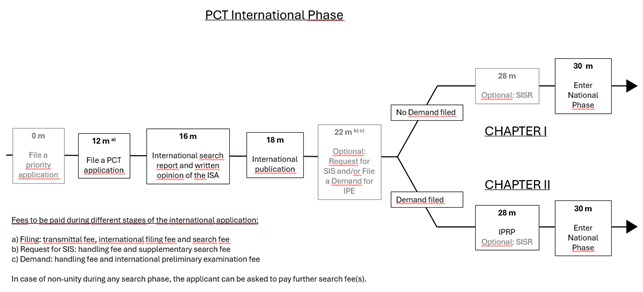
A first application or an application claiming priority from an earlier application (within 12 months), can be filed with a receiving office (rO) or directly with the International Bureau (IB). Any resident or national of a contracting state can file an international application. The language in which the application can be filed depends on the rO. Finland, for instance, accepts applications filed in English, Finnish, or Swedish. The requirement of use of an agent also varies between rOs. In Finland, the use of an agent is required if the applicant is a non-resident.
In order to receive a filing date, the request must contain an indication of an international application to be processed according to the PCT, indication of the applicant’s choice of competent international searching authority (ISA), and application documents including: title of invention, description, at least one claim, and drawings where applicable. Further, the international filing fee, transmittal fee, and search fee are to be paid.
Upon receipt of the PCT application the rO proceeds with conducting of a formalities check. If the application passes the formality check the application is transferred to the ISA of the applicant’s choosing. Sometimes you can choose between different ISAs (like when Finland is rO the ISAs can be the Finnish or Swedish patent office or the EPO; if, however, the EPO is rO, the ISA can only be EPO). When the ISA has conducted the search, it will establish a report regarding prior art and at the same time a preliminary, non-binding written opinion on novelty, inventive step and industrial applicability. The ISA aims to establish the international search report (ISR) and written opinion (WO/ISA) within 9 months from the application date or 16 months from the priority date, when the priority is claimed from an application filed not more than 12 months earlier.
Upon receipt of the ISR and WO/ISA there is an option to make amendments to the application and to have them published. A complete set of claims to replace the earlier claims together with a letter indicating the differences and the basis for the amendments shall be filed directly with the IB within two months from mailing date of ISR (or 16 months from the priority date whichever expires later). The amendments will be published with the international application. It is noteworthy that these amendments will not be examined during the international phase (unless a Demand is filed) and may be the used as basis in the national phase. Most often no amendments are filed, unless a Demand is filed, too.
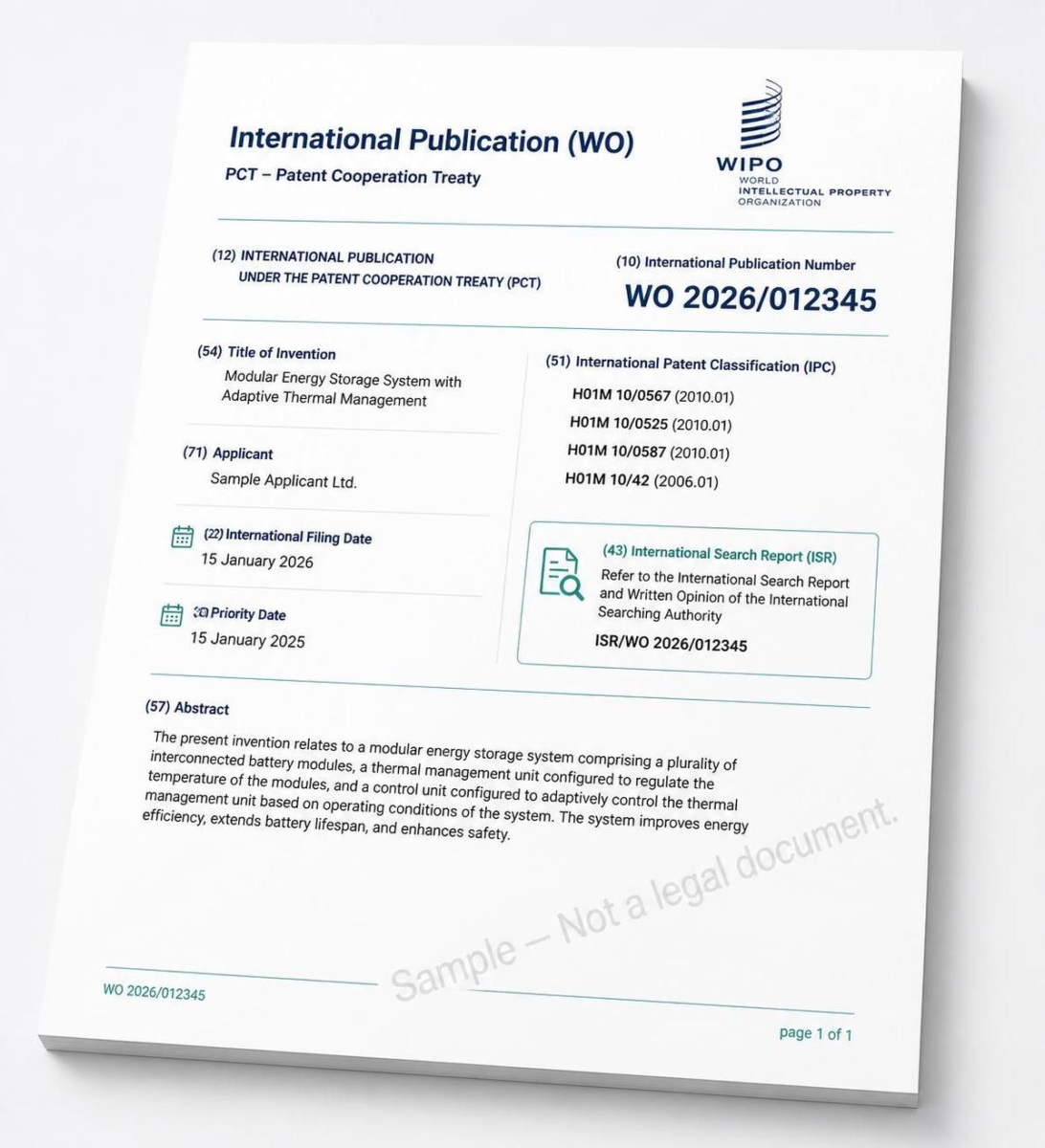
The IB is responsible for the international publication of the PCT application. The publication takes place shortly after 18 months from the priority date. If, however, you wish for an earlier publication it can be requested separately. On the other hand, if you wish to prevent the publication of the application the application must be withdrawn before the technical preparations of the publication have been completed, i.e. 15 days before publication. By withdrawing a request for priority before the technical preparations of the publication have been completed, the publication can be postponed.
The international application is published in electronic form on the WIPO website.
After the international publication, the content of the application becomes prior art from the day of publication and the application may provide a provisional protection in the designated or elected states. The application can be published in Arabic, Chinese, English, French, German, Japanese, Korean, Portuguese, Russian, or Spanish. Thus, applications filed in any other language need to be translated into one of the publication languages.
If the applicant is not satisfied with the preliminary patentability opinion of the ISA, there is a possibility to request examination by filing a Demand for an international preliminary examination (IPE), typically referred to as “Demand”. Filing of the Demand is not mandatory. A Demand may be filed up until 22 months from the priority date or 3 months from the date of transmittal of ISR and WO, whichever expires later. The IPE is carried out by an International Preliminary Examination Authority (IPEA). The IPEA establishes the international preliminary examination report on patentability (IPRP), which is non-binding to the national/regional offices. Before or when filing a Demand, the applicant has a possibility to amend the application text (claims, description and drawings). The amendments and arguments are preferably filed with the Demand but should be filed at least within the time limit of filing the Demand. Unless the IPEA is convinced by the amendments and/or arguments, it should issue at least one written opinion (WO/IPEA) before the IPER. It is possible to receive more than one written opinion from the IPEA if the Demand is filed early and if the response to the first WO/IPEA is filed without delay.
One way to obtain a complementary search is by requesting one or more Supplementary International Searches (SIS). The request for this search shall be made within 22 months from the priority date and the request shall be filed with the IB. While it is possible for that the ISA and the IPEA are the same authority, the Supplementary International Search Authority (SISA) is different from ISA. Offices of only ten of the contracting states can serve as SISA including Finland, the EPO, Sweden, Austria, and Ukraine. However, it is also worth noting that offices of countries like the United States, Germany, Denmark, China, and Japan are not SISAs. When the SISA has conducted the supplementary search, a report will be established (SISR). Similarly to the ISR and WO/ISA, the SISR contains the cited prior art with the SISAs opinion. Use of SIS is very rare, probably due to the small number of SISAs. Indeed, should it be possible to request SIS from an office such as Japan, Korea or China, i.e. countries for which older documents are not available as machine translations, it might be more popular.
As mentioned in the beginning, the international phase does not proceed to a granted patent, it ends with the applicant’s decision to proceed to the national or regional phase (such as EP), taking the international application further to the designated or elected offices. Please note that the offices are called designated offices if the application has completed Chapter I and elected offices if a Demand has been made and the application has completed Chapter II. The differences between a designated and an elected office are the terminology, legal basis, and a difference in time limits for entering the national phase. In practice, all countries nowadays apply the 30- or 31-months’ time limit, even without Demand.
In order to enter the national phase, there are different requirements for each country/region. Typically, it can involve appointing a foreign attorney as representative, filing formal documents, submitting translation of the application into a local official language, and paying official fees. After entry the patent application is handled according to national/regional requirements. All local laws, rules and time limits must be followed.
The PCT-route can provide advantages when you aim to search for protection worldwide or when you need more time to decide in which countries to seek protection. With a PCT-application you can reserve the right to apply for broader geographical protection for as long as 2.5 years from the date of filing the priority application, compared to one year with direct filings. At the same time the costs for national proceedings are postponed.
While the postponement of decision making is an advantage in the early years of the application, it can be a disadvantage in the long run, since it may take longer for a patent to be granted. It could also be mentioned that the overall costs may be higher when choosing the PCT-route.
On the other hand, the PCT route offers noticeable advantages in that you will receive a search report and optionally an examination report before making the decision about continuation and that a part of the process can be handled centrally through a Demand (PCT Chapter II). If a Demand is filed and results in a positive report from the IPEA, such as the EPO, this can sometimes help facilitate prosecution in a number of countries, potentially leading to fewer office actions and, in some cases, somewhat lower overall costs. At the same time, the value of filing a Demand will depend on your specific situation and may be more limited if protection is sought in only a small number of jurisdictions, such as the EP and US.
A PCT application can also provide a useful opportunity to further evaluate the commercial potential of the invention while maintaining a degree of uncertainty for competitors during the international phase.
| Abbreviation | Definition | Abbreviation | Definition |
|---|---|---|---|
| rO | Receiving Office | IPEA | Preliminary Examining Authority |
| IB | WIPO Bureau | WO/IPEA | IPEA Written Opinion |
| ISA | Searching Authority | IPER | Preliminary Examination Report |
| ISR | Search Report | IPRP | Patentability Report |
| WO | Publication Prefix | SIS | Supplementary Search |
| WO/ISA | ISA Written Opinion | SISR | Supplementary Search Report |
| IPE | Preliminary Examination | dO | Designated Office (Ch. I) |
| eO | Elected Office (Ch. II) |
Any questions? Please contact our experts for further information – we’ll be glad to help you!

Laine IP Oy
Contact Details
Tel: (09) 6859 560
Fax: (09) 6859 5610
Email: posti@laineip.fi
Personnel Contact Information
Mailing Address
Laine IP Oy
PL 339
00181 Helsinki
Subscribe our Newsletter
Follow Us


Billing Information
Business ID: 0590525-5
VAT Number: FI05905255
Operator: Nordea
Operator ID: NDEAFIHH
e-Invoice Address: FI6221531800060138
 Contact
 Search
 Pia Lindblom