
-
Services
-
These achievements have been made possible by our experts and collaboration with our dedicated clients and foreign partners. We thank both our clients and partners for their trust and feedback.
For more than 20 years, the prestigious Managing IP publication in the IPR industry has assessed the quality of work and customer satisfaction of patent and trademark attorneys through its annual survey. The IP STARS ranking is based on extensive interviews and surveys of IPR professionals and clients covering more than 80 countries. It has become one of the most respected and well-known indicators in the IPR field.
Ceipi, center for international intellectual property studies (part of University of Strasbourg) organises again its traditional Ceipi Summer School on IP in Europe-seminar, this year online.
The seminar covers protection of various industrial property rights in Europe, but also for example court practices and the effect of EU legislation on IP. The participants also have a possibility to follow a series of pre-recorded videos, that cover issues that cannot be covered in depth during the seminar.
The seminar is aimed at European and non-European students, IP attorneys and lawyers.
Laine IP’s European patent attorney Kaisa Suominen tutors at the seminar with two colleagues, Daniel X. Thomas (former director at the EPO) and Claire Mouget-Goniot (EPA, IPAZ). Their subject-matter is oral proceedings at the EPO. Traditionally, the session has included an overview of oral proceedings and a brief mock oral proceedings. This year the schedule is tighter, thus the session will mainly focus on why oppositions are filed, what are the roles of the different parties in the proceedings, both during the opposition proceedings in general and during the oral proceedings in particular.
Read more: https://www.ceipi.edu/en/training-seminars/summer-school/
No worries, it might still be possible, just contact your IPR partner.
Should one wish to obtain protection for an Invention or a design, no publication should take place before filing of the application. Thus, it is best to contact your IPR partner well in advance of any publication. Sometimes one can however forget it, or one does not think about protection in advance. Is all hope lost in such a case?
In many countries yes, but luckily not in all, depending on the form of protection. In such cases it is possible to take advantage of the so-called grace period. Grace period denotes the time that starts from publication of the invention or design, and during which it is still possible to apply for protection in certain countries.
For patents, the grace period is known, among the most common countries, only in the US, Canada, Australia, Korea and Japan, and lasts 12 months. In Russia, the grace period exists but lasts only 6 months. The European Patent Convention and for example the patent law of Chine does not recognise such grace period.
In most countries one must, upon filing, inform the patent office that grace period is to be applied, i.e., such notification cannot be added at a later stage. Typically, it is not possible to benefit from the grace period in cases where the publication was as a patent application or a granted patent. Also, for most countries, the time limit is calculated backwards from the date of filing, not the date of priority. This means that depending on the country, one must file either directly a national patent application or a PCT-application within 6 or 12 months from the publication.
In most countries, it is also possible to obtain protection via a patent even after someone else has published the invention, without permission from the owner of the invention. For example, at the European Patent Office (EPO) and in China the time limit is 6 months from publication. Often one needs to be able to prove the unpermitted publication, and for example at the EPO, it is required that the publication was made with an intention to harm the owner of the invention.
For designs, grace period is available in several countries, and its length varies from 3 to 12 months. However, for example in China a grace period for designs is not recognised, either, and it is thus not possible to apply for a design registration in China after disclosure In Finland, within the EU and in the US, the grace period is 12 months.
Should the time limit for taking advantage of the grace period be already over, it is possible to try to find a feature in the invention that is not yet public and based on which it would still be possible to apply for a patent. For designs, it is similarly possible to modify the design in such a manner that it fulfils the requirements of novelty and individual character, or it might be possible to obtain protection for a three-dimensional trademark. In the EU, a so-called unregistered Community design is also recognised. One can claim such protection provided the first disclosure of the design has taken place within the EU, and that the design was novel and had individual character at the time. The disadvantages of an unregistered Community design include narrow scope of protection and, compared to a registered Community design, a significantly shorter period of protection, only three years from disclosure. In some countries, it is also possible to register a copyright, which is worth considering in case other forms of protection are not available.
Trademarks do not have a similar requirement for novelty as designs and patents, but also for trademarks, it is recommended to apply for protection at an early stage. Without a registered trademark, it may for instance be difficult and time-consuming to prevent any unauthorised use by others.
If you or your company have concerned or foresee a threat of potential litigation from a US patent owner, there are presently three (3) primary avenues to challenge the validity of the US patent outside of a Federal courtroom and within the United States Patent and Trademark Office (USPTO). The three avenues are: Post-Grant Review, Inter Partes Review, and Ex Parte Reexamination. The differences there between and key features of each are summarized in the Table below. One key difference, for example, is that Post Grant Review is available to attack patent validity on any basis while Inter Partes Review and Ex Parte Reexamination are limited to novelty/obviousness challenges based on printed publications.
If you or your company have concerns over any third party’s patent, please contact a member of our US Team to discuss your concerns.
|
SUMMARY OF U.S. POST-GRANT PATENT CHALLENGE PROCEEDINGS |
|||
| Post-Grant Review | Inter Partes Review | Ex Parte Reexamination | |
| Expected Costs | 175-250,000+ USD | 100-200,000+ USD | 20-50,000+ USD |
| Expected Timeframe | 12-18 months with an aim of under 12 months. | 18-24 months | 2-3 years |
| Who can initiate proceeding? | Any third party except for a plaintiff challenging validity of the subject patent in a US court. | Any third party except for a plaintiff challenging validity of the subject patent in a US court. | The Patent Owner or a Third Party, including USPTO Director. |
| Window for Filing | No later than 9 months after patent issuance or issuance of reissue (patent must have an effective filing date on or after March 16, 2013). | Later of: (i) on or after 9 months after patent issuance or issuance of reissue; or (ii) termination of Post-Grant Review. 1 | Anytime during enforceability of patent (may be 6 years past expiration due to past damages). |
| Basis for Attacking Validity of the Subject Patent(s) | Any ground (except for failure to comply with the best mode requirement). | 35 USC § 102 (novelty) and/or 35 USC § 103 (obviousness) based upon one or more patents and/or printed publications. | 35 USC § 102 (novelty) and/or 35 USC § 103 (obviousness) based upon one or more patents and/or printed publications. |
| Standard to Overcome for Initiating Proceeding | “More likely than not” that at least one of the claims challenged is unpatentable. | A “reasonable likelihood that the petitioner would prevail” with respect to at least one challenged claim. | Substantial New Question of Patentability. |
| Anonymity | No, all real parties in interest must be identified. | No, all real parties in interest must be identified. | Yes, can be anonymous. |
| Extent of Estoppel | After a final decision (by PTAB), the petitioner, third party, or privy of the petitioner is estopped from challenging the patent(s) in the USPTO, ITC or district court on any ground the real party of interest raised or which could have been reasonably raised in the Post Grant Review. 2 | After a final decision (by PTAB), the petitioner, third party, or privy of the petitioner is estopped from challenging the patent(s) in a district court on any ground the real party of interest raised or which could have been raised in the Inter Partes Review. 3 | None officially, but may be tougher to overcome similar arguments which failed downstream. |
| Effect on Concurrent Proceeding | If a court case for invalidity was filed, a Post Grant Review cannot be filed; if a Post Grant Review is filed, then later filed court proceeding automatically stayed. | If a court case for invalidity was filed, an Inter Partes Review cannot be filed; if an Inter Partes Review is filed, then later filed court proceeding automatically stayed. | No effect. |
| Third Party Involvement following initiation | Post grant Review provides for limited discovery, a Petitioner reply, and an oral hearing before a three judge panel before a decision on the merits. | Inter Partes Review provides for limited discovery, a Petitioner reply, and an oral hearing before a three judge panel before a decision on the merits. | None, unless the patent owner files a statement which rebuts the requester’s assertion(s) of a substantial new question of patentability. 4 |
| USPTO Branch Handling Proceeding | Patent Trial and Appeal Board (PTAB) | Patent Trial and Appeal Board (PTAB) | Different Examiner(s) from that of Examination |
[1] Also, note per 35 U.S.C. 315(b), an Inter Partes Review may not be instituted if the petition requesting the proceeding is filed more than 1 year after the date on which the petitioner, real party in interest, or privy of the petitioner is served with a complaint alleging infringement of the patent.
[2] See also 35 U.S.C. 325(e)(2) stating “The petitioner in a post-grant review of a claim in a patent under this chapter that results in a final written decision under section 328(a), or the real party in interest or privy of the petitioner, may not assert either in a civil action arising in whole or in part under section 1338 of title 28 or in a proceeding before the International Trade Commission under section 337 of the Tariff Act of 1930 that the claim is invalid on any ground that the petitioner raised or reasonably could have raised during that post-grant review.”
[3] See also 35 U.S.C. 315(e)(2) stating “The petitioner in an inter partes review of a claim in a patent under this chapter that results in a final written decision under section 318(a), or the real party in interest or privy of the petitioner, may not assert either in a civil action arising in whole or in part under section 1338 of title 28 or in a proceeding before the International Trade Commission under section 337 of the Tariff Act of 1930 that the claim is invalid on any ground that the petitioner raised or reasonably could have raised during that inter partes review.”
[4] See 37 C.F.R. 1.535.
Revocation at PRH is possible only based on non-use of the trade name. If the trade name has been registered contrary to law, cansellation action needs to brought at the Market Court.
Revocation of a trade name requires that it causes harm. The trade name may, for instance, form an unnecessary obstacle to a later trade mark or trade name of someone else. Revocation may be applied for if the trade name has not been used in the past five years and there are no acceptable reason for non-use. PRH may cancel the registration of the trade name in its entirety or partially by restricting the line of business if registered too broadly.
If you have any questions regarding this topic, please do not hesitate to contact our experts.
A divisional patent application is a type of patent application, which contains subject matter disclosed in a previously filed parent application. Typically, the description and drawings of such divisional application are identical with or similar to the parent application. However, the claims of the divisional application defining the scope of protection must be different to the claims of the parent application. It is not possible to add new subject matter (new information) to the divisional application, i.e. the divisional application can only be based on what is disclosed in the parent application.
In other words, by filing of a divisional application it is potentially possible to obtain patent protection for aspects or viewpoints not claimed but disclosed in the parent application. The divisional application will be considered as an independent patent application after filing, i.e. its prosecution is not dependent on the parent application. It will expire at the latest at the same time as the parent application.
The last possible moment for filing a divisional application varies from one country to another. For example, at the European Patent Office, filing of a divisional application is only possible as long as the parent application is pending, i.e. before grant of a patent in the parent case. In some countries, it is only possible to file a divisional before replying to a first office action, while in others, it may even be possible to file a divisional shortly after grant.
This depends on the country and the possible last moment for filing the divisional. A brief consideration should ideally be made every time the claims are amended, i.e. to think whether the possible deleted subject-matter could still be pursued in a divisional application. Similarly, in case the application has on purpose been drafted such that it contains unclaimed subject-matter in its description, this is good to keep in mind during prosecution of the application.
Generally, filing of a divisional application is available in most jurisdictions.
Filing of one or more divisional application(s) can i.a. provide the following advantages:
The costs for filing and prosecution of a divisional application are similar to the costs of filing and prosecution in the parent case. However, in some jurisdictions, such as at the European Patent Office, all renewal fees that have been due for the parent application, must also be paid for the divisional application upon filing.
Filing of a divisional application is of particular interest with regards to technology considered as future core technology.
Filing of a divisional application is of particular interest with regards to future core markets. The need to file a divisional application also depends on the expected scope of protection in a given jurisdiction.
Should you have any questions, please, do not hesitate to contact us!
“Laine IP is driven by a passion for trademark law and brands. It positions itself as a trusted partner to the businesses it assists and has astutely developed its offering to include services lines that fuel company growth and strengthen existing frameworks. Anchoring the practice, Tom-Erik Hagelberg stands out for his energy, enthusiasm and no-nonsense approach. Although equally adroit on both sides of the contentious/non-contentious divide, Hagelberg is best known for his finely honed strategies and opposition capabilities.”

Tom-Erik Hagelberg
WTR1000 is the only independent definitive guide dedicated to identifying the world’s leading trademark professionals and firms in over 80 jurisdictions around the globe. All the WTR1000 rankings for Finland can be found here.
Press release for the WTR 1000 can be found here.
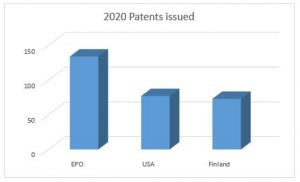
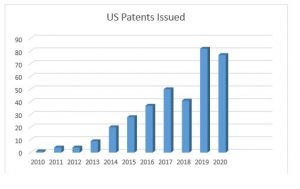
We are pleased to announce that our firm was the representative of record for our clients on: 134 granted European (EPO) patents; 77 issued US patents; and 73 granted Finnish patents in 2020.
The 77 issued US patents brought the overall total number of US issued patents to over 350 for Laine IP Oy’s internal US Team since its creation in 2010.
We wish our clients continued success in 2021!
In November we published a brief article about EPO’s new practices relating to oral proceedings. Some changes came into effect with the new year, namely with respect to Boards of Appeal and hearing of witnesses.
Previously, a Board of Appeal could only hold oral proceedings by ViCo if all the parties agreed. As of 1.1.2021, the decision is at the Board’s hands, and no consent is needed from the parties.
Additionally, the EPO changed its practice (as well as rules 117 and 118 of the European Patent Convention) as of 1.1.2021 to allow hearing of a witness also by ViCo. For any oral proceedings held by ViCo, the witness must also be heard by ViCo and in the presently unlikely event of the oral proceedings being held at the premises of the EPO, the witness can still be heard by ViCo. Hearing of witnesses is not that common during EPO prosecutions, most cases concern oppositions where a public prior use has been presented against novelty. In such a case, a witness may be required to be heard to prove such use.
Merry Christmas and Happy New Year!
We thank you all for the past year and
look forward to a successful 2021.
Laine IP Oy
* * *
This year we have made a donation to the Finnish Medical Foundation.

Laine IP Oy
Contact Details
Tel: (09) 6859 560
Fax: (09) 6859 5610
Email: posti@laineip.fi
Personnel Contact Information
Mailing Address
Laine IP Oy
PL 339
00181 Helsinki
Subscribe our Newsletter
Follow Us


Billing Information
Business ID: 0590525-5
VAT Number: FI05905255
Operator: Nordea
Operator ID: NDEAFIHH
e-Invoice Address: FI6221531800060138
 Contact
 Search