
-
Services
-
In March 2026, Business Finland opened the Sprint funding call for small companies with a new innovation and strong potential for rapid international growth. The Sprint funding will now continue, and the application period will open again on September 1, 2026.
Sprint funding is primarily intended as a first R&D funding instrument for new companies (under five years old companies), as well as for established companies (at least five years old companies) seeking significant business growth and renewal through the development of a new innovation.
Sprint funding is granted to projects that develop new and innovative solutions and assess their technical feasibility, customer demand, and market potential. A company can apply for €75,000–€100,000 in funding. You can find the detailed funding criteria and instructions for applying on Business Finland’s website.
The funding can be used for studies, plans, and initial applications related to industrial property rights. Purchased expert services are accepted as project costs. It is important to note that only purchases and work for which a written agreement or order has been made after submitting the funding application can be approved for the project.
Feel free to get in touch — we are happy to assist with, for example, patentability assessments, freedom-to-operate analyses, drafting patent applications, and trademark protection.
A new referral to the Enlarged Board of Appeal (EBoA) of the EPO, relating to claim interpretation is now pending. Also this referral relates to decision G1/24 (see our news item on decision G1/24), as according to this decision, the description is to always be used to interpret the claims. The first referred question relates to the possibility to refer a question to the EBoA.
The decision at the base of this referral, T873/24, relates to a coated strip of steel. The content of titanium, but not nitrogen, in the strip is given in weight percentages. Furthermore, the ratio titanium-nitrogen is given.
The patent under opposition is based on a second generation divisional application. The applications as filed of the earlier generations indicate, in their claims, that this ratio is based on weight. This is also mentioned in the application as filed of this divisional, in a dependent claim.
However, in the granted claim it is not specified what the ratio is based on. According to the opposition division, the ratio cannot be based on anything else than the weight percentages, when taking into account the claim as a whole, as well as the description. The patetee agrees with this interpretation, the opponent does not.
According to the opponent, the fact that the claim does not contain any information as to what the ratio is based on, is a deliberate broadening of the scope of protection by the patentee. The Board of Appeal (BoA) agrees. According to the BoA, the arguments by the opposition division and the patentee, that the ratio can only be based on weight, are not convincing. The patentee also agrued that the alleged broadening would be supported by the application as filed, but also this argument did not convince the BoA.
The Board goes through decisions taken after G1/24, and concludes that the interpretation of this decision varies. In a small number of decisions, the description is only used for defining the skilled person’s knowledge, while in a larger number of decisions it has been concluded that it is not possible to extend or limit the scope of protection of a claim without such feature(s) being present in the claim. It has not been deemed acceptable to interprete a feature of the claim in a broad manner, based on the description, when the feature itself is both clear and technically credible for the skilled person.
The Board also found a third approach to decision G1/24, which they call holistic approach. In this approach, the patent as a whole is used to determine how a skilled person would understand the terms used in the claims. In this approach, the claims are read and the description and drawing consulted in a uniform manner.
The Board concludes that based on the two first interpretations, the claim does extend beyond the application as filed, while application of the third approach would lead to a conclusion of no added subject-matter. Therefore, the BoA can refer the question to EBoA, since the decisions of the Boards diverge.
This referral has an impact on numerous proceedings, but no proceedings are interrupted because of this referral.
The new referral asks the following questions.
1. May a decisionbe considered to be “required” for the purposes of Article 112(1) EPC, if the referring Board demonstrates that the point of law in question arises out of the context of the case pending before it and, in the circumstances of the proceedings, it is reasonable for the Board to examine it and decide on it next?
2.(a) Does the fact that the claims are the starting point and the basis for assessing the patentability of an invention generally preclude a feature which is only disclosed in the description or the drawings of a patent from being read into the meaning of a granted claim, in particular if this leads to a restrictive reading of terms used in the claim?
2.(b) If the answer to question 2.(a) is no: is claim interpretation the result of both reading the claims and consulting the description and drawings as a unitary process and does the claim being the starting point and the basis for assessing the patentability rule out only those interpretations which can be derived from the patent as a whole but would clearly contradict the general technical understanding of the terms used in the claim?
3.(a) When assessing compliance with Article 123(2) EPC, must a term used in a claim be assessed against all interpretations that make technical sense to the skilled reader on the basis of the claim alone?
3.(b) If the answer to question 3.(a) is no: is it sufficient that only the interpretations of the subject-matter of the claim established against the background of the patent specification as a whole are directly and unambiguously derivable from the application as filed?
Related links:
T873/24: https://www.epo.org/en/boards-of-appeal/decisions/t240873ex1
G1/24: https://www.epo.org/en/boards-of-appeal/decisions/g240001ep1?term=%22G%200001%5C%2F24%22%20
News item on Decision G1/24: https://www.laineip.fi/en/decision-g1-24-the-description-is-always-to-be-used-to-interpret-the-claims/
Managing Intellectual Property’s IP Stars research is the most comprehensive and prestigious assessment of the global intellectual property profession, evaluating IP firms and practitioners across more than 80 countries. The rankings are based on extensive market research, client feedback, peer reviews, and the quality and volume of the firms’ IP work.
Laine IP Oy once again maintained its Top Tier rankings in both the Patent Prosecution and Trademark Prosecution categories.
Our experienced professionals Kathy Wasström (Patent Star), Tom-Erik Hagelberg (Trademark Star), Reijo Kokko (Trademark Star), and Joose Kilpimaa (Trademark Star) were recognized as MIP Stars.




In addition, our experts Tiia-Riikka Kittilä, Joni Vehmas, Jemina Koskela, and Liisa Sarnes-Salokoski received the Rising Star distinction. This recognition is awarded to emerging professionals who have demonstrated outstanding expertise and commitment in the field of intellectual property.




We would like to extend our sincere thanks to our clients for their trust and for the valuable feedback they provided during the research process. These recognitions inspire us to continue delivering high-quality expertise and personalized service in close collaboration with our clients.
Just a quick note that our office will be closed from 19th to 21st June due to the Midsummer holiday. After the Midsummer holiday, we will be back to our normal business hours and available throughout the summer as usual.
Thank you for your patience and understanding.
Have a great weekend!
PCT, Patent Corporation Treaty, (effective since 1978) is an international patent system for filing, preliminary examining and publishing patent applications. However, it is not a patent granting system but an international patent application system. PCT is a special agreement under the Paris Convention to promote the international cooperation in the field of patents. Through the PCT system the applicant has a possibility to access over 158 states with one single international patent application. The most recent states to join are Uruguay, Mauritius, Cabo Verde, Iraq, and Jamaica. Argentina, Taiwan, Pakistan, Bangladesh, and Afghanistan are examples of states that are not PCT member states.
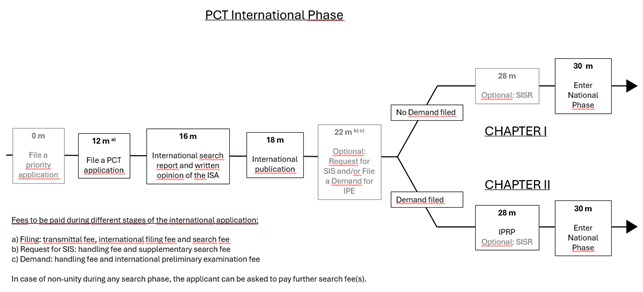
A first application or an application claiming priority from an earlier application (within 12 months), can be filed with a receiving office (rO) or directly with the International Bureau (IB). Any resident or national of a contracting state can file an international application. The language in which the application can be filed depends on the rO. Finland, for instance, accepts applications filed in English, Finnish, or Swedish. The requirement of use of an agent also varies between rOs. In Finland, the use of an agent is required if the applicant is a non-resident.
In order to receive a filing date, the request must contain an indication of an international application to be processed according to the PCT, indication of the applicant’s choice of competent international searching authority (ISA), and application documents including: title of invention, description, at least one claim, and drawings where applicable. Further, the international filing fee, transmittal fee, and search fee are to be paid.
Upon receipt of the PCT application the rO proceeds with conducting of a formalities check. If the application passes the formality check the application is transferred to the ISA of the applicant’s choosing. Sometimes you can choose between different ISAs (like when Finland is rO the ISAs can be the Finnish or Swedish patent office or the EPO; if, however, the EPO is rO, the ISA can only be EPO). When the ISA has conducted the search, it will establish a report regarding prior art and at the same time a preliminary, non-binding written opinion on novelty, inventive step and industrial applicability. The ISA aims to establish the international search report (ISR) and written opinion (WO/ISA) within 9 months from the application date or 16 months from the priority date, when the priority is claimed from an application filed not more than 12 months earlier.
Upon receipt of the ISR and WO/ISA there is an option to make amendments to the application and to have them published. A complete set of claims to replace the earlier claims together with a letter indicating the differences and the basis for the amendments shall be filed directly with the IB within two months from mailing date of ISR (or 16 months from the priority date whichever expires later). The amendments will be published with the international application. It is noteworthy that these amendments will not be examined during the international phase (unless a Demand is filed) and may be the used as basis in the national phase. Most often no amendments are filed, unless a Demand is filed, too.
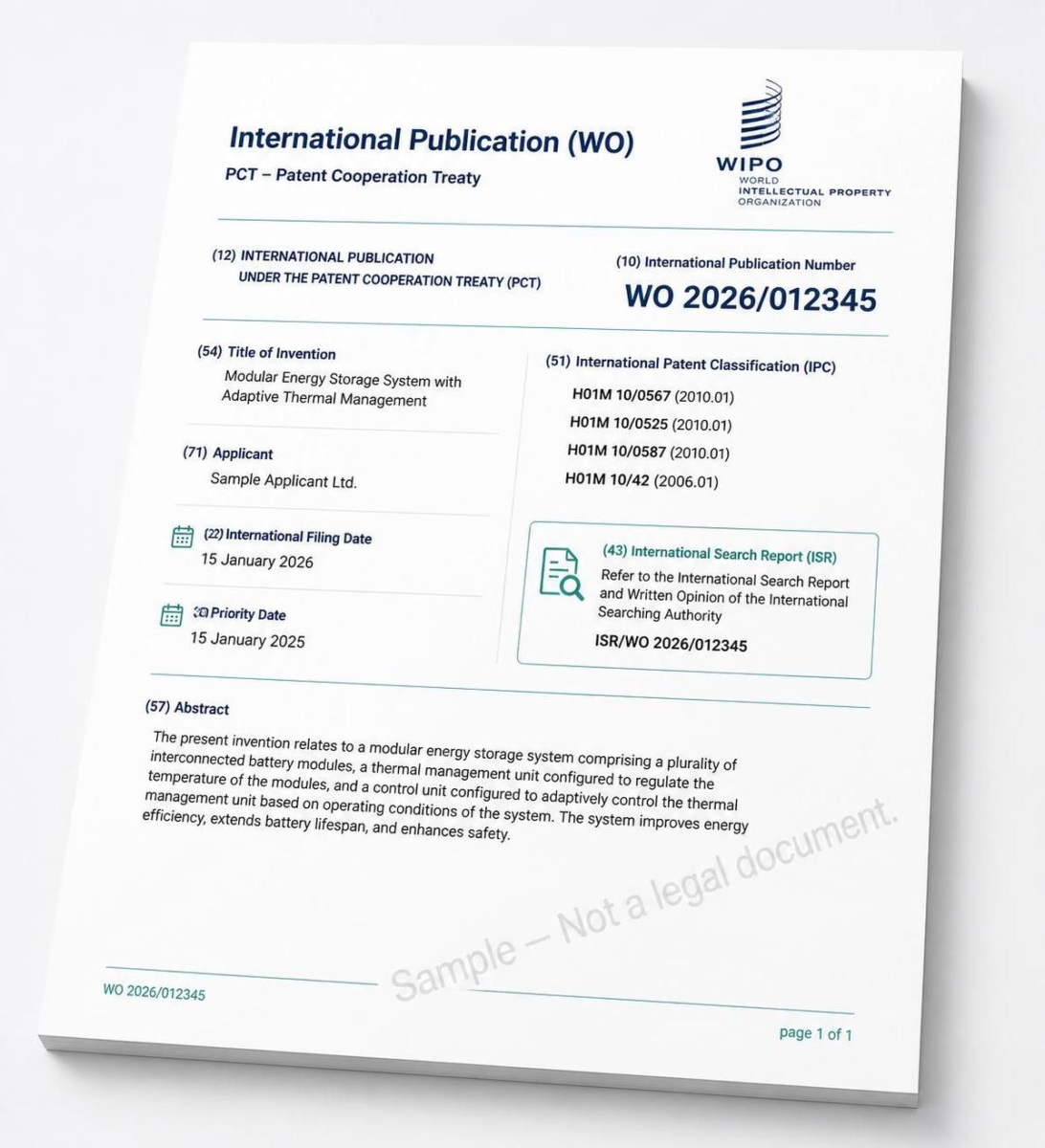
The IB is responsible for the international publication of the PCT application. The publication takes place shortly after 18 months from the priority date. If, however, you wish for an earlier publication it can be requested separately. On the other hand, if you wish to prevent the publication of the application the application must be withdrawn before the technical preparations of the publication have been completed, i.e. 15 days before publication. By withdrawing a request for priority before the technical preparations of the publication have been completed, the publication can be postponed.
The international application is published in electronic form on the WIPO website.
After the international publication, the content of the application becomes prior art from the day of publication and the application may provide a provisional protection in the designated or elected states. The application can be published in Arabic, Chinese, English, French, German, Japanese, Korean, Portuguese, Russian, or Spanish. Thus, applications filed in any other language need to be translated into one of the publication languages.
If the applicant is not satisfied with the preliminary patentability opinion of the ISA, there is a possibility to request examination by filing a Demand for an international preliminary examination (IPE), typically referred to as “Demand”. Filing of the Demand is not mandatory. A Demand may be filed up until 22 months from the priority date or 3 months from the date of transmittal of ISR and WO, whichever expires later. The IPE is carried out by an International Preliminary Examination Authority (IPEA). The IPEA establishes the international preliminary examination report on patentability (IPRP), which is non-binding to the national/regional offices. Before or when filing a Demand, the applicant has a possibility to amend the application text (claims, description and drawings). The amendments and arguments are preferably filed with the Demand but should be filed at least within the time limit of filing the Demand. Unless the IPEA is convinced by the amendments and/or arguments, it should issue at least one written opinion (WO/IPEA) before the IPER. It is possible to receive more than one written opinion from the IPEA if the Demand is filed early and if the response to the first WO/IPEA is filed without delay.
One way to obtain a complementary search is by requesting one or more Supplementary International Searches (SIS). The request for this search shall be made within 22 months from the priority date and the request shall be filed with the IB. While it is possible for that the ISA and the IPEA are the same authority, the Supplementary International Search Authority (SISA) is different from ISA. Offices of only ten of the contracting states can serve as SISA including Finland, the EPO, Sweden, Austria, and Ukraine. However, it is also worth noting that offices of countries like the United States, Germany, Denmark, China, and Japan are not SISAs. When the SISA has conducted the supplementary search, a report will be established (SISR). Similarly to the ISR and WO/ISA, the SISR contains the cited prior art with the SISAs opinion. Use of SIS is very rare, probably due to the small number of SISAs. Indeed, should it be possible to request SIS from an office such as Japan, Korea or China, i.e. countries for which older documents are not available as machine translations, it might be more popular.
As mentioned in the beginning, the international phase does not proceed to a granted patent, it ends with the applicant’s decision to proceed to the national or regional phase (such as EP), taking the international application further to the designated or elected offices. Please note that the offices are called designated offices if the application has completed Chapter I and elected offices if a Demand has been made and the application has completed Chapter II. The differences between a designated and an elected office are the terminology, legal basis, and a difference in time limits for entering the national phase. In practice, all countries nowadays apply the 30- or 31-months’ time limit, even without Demand.
In order to enter the national phase, there are different requirements for each country/region. Typically, it can involve appointing a foreign attorney as representative, filing formal documents, submitting translation of the application into a local official language, and paying official fees. After entry the patent application is handled according to national/regional requirements. All local laws, rules and time limits must be followed.
The PCT-route can provide advantages when you aim to search for protection worldwide or when you need more time to decide in which countries to seek protection. With a PCT-application you can reserve the right to apply for broader geographical protection for as long as 2.5 years from the date of filing the priority application, compared to one year with direct filings. At the same time the costs for national proceedings are postponed.
While the postponement of decision making is an advantage in the early years of the application, it can be a disadvantage in the long run, since it may take longer for a patent to be granted. It could also be mentioned that the overall costs may be higher when choosing the PCT-route.
On the other hand, the PCT route offers noticeable advantages in that you will receive a search report and optionally an examination report before making the decision about continuation and that a part of the process can be handled centrally through a Demand (PCT Chapter II). If a Demand is filed and results in a positive report from the IPEA, such as the EPO, this can sometimes help facilitate prosecution in a number of countries, potentially leading to fewer office actions and, in some cases, somewhat lower overall costs. At the same time, the value of filing a Demand will depend on your specific situation and may be more limited if protection is sought in only a small number of jurisdictions, such as the EP and US.
A PCT application can also provide a useful opportunity to further evaluate the commercial potential of the invention while maintaining a degree of uncertainty for competitors during the international phase.
| Abbreviation | Definition | Abbreviation | Definition |
|---|---|---|---|
| rO | Receiving Office | IPEA | Preliminary Examining Authority |
| IB | WIPO Bureau | WO/IPEA | IPEA Written Opinion |
| ISA | Searching Authority | IPER | Preliminary Examination Report |
| ISR | Search Report | IPRP | Patentability Report |
| WO | Publication Prefix | SIS | Supplementary Search |
| WO/ISA | ISA Written Opinion | SISR | Supplementary Search Report |
| IPE | Preliminary Examination | dO | Designated Office (Ch. I) |
| eO | Elected Office (Ch. II) |
Any questions? Please contact our experts for further information – we’ll be glad to help you!
The IAM Patent 1000 is a globally respected guide dedicated exclusively to patent expertise and serves as a key benchmark for companies seeking top-tier patent service providers worldwide. Its latest assessment reaffirms Laine IP’s strong position as a leading patent expert in Finland.
Laine IP was awarded a Silver tier ranking in the patent prosecution category in Finland, further strengthening its position as one of the country’s foremost patent firms. According to IAM, “Laine IP stands as one of the best patent agencies in Finland, specialising in top-tier patent prosecution work.” The firm is particularly recognized for its direct, efficient, and responsive way of working, as well as its ability to serve both local start-ups and major conglomerates.
The survey highlights the breadth of expertise within Laine IP’s team and its ability to provide high-quality, client-focused patent services across a wide range of technologies. In the IAM Patent 1000 guide, a total of seven Laine IP professionals were listed as recommended individuals, reflecting the firm’s deep and wide-ranging expertise across multiple technology areas.
Special recognition is given to CEO, European Patent Attorney Jouni Smolander; Chairman of the Board, European Patent Attorney Toimi Teelahti; and Board Member, European Patent Attorney Jarkko Tiilikainen, all of whom play key roles in the firm’s continued success.



Laine IP’s chemistry team, in particular, European Patent Attorneys Kaisa Suominen, Kathy Wasström, and Hanna Laurén along with US Patent Attorney Mark Scott from our US team, are also praised for their high-level expertise and versatility.




Laine IP’s success in the IAM Patent 1000 rankings is built on strong expertise and the trust of our clients. We would like to thank our clients and partners for their continued support and valuable feedback, which enables us to continuously develop our services.
A link to the 2026 IAM 1000 Listing and Laine IP’s recognitions can be found here:
https://www.iam-media.com/rankings/patent-1000/profile/firm/laine-ip-oy
Laine IP Oy is looking for a motivated and detail oriented U.S. Patent Agent Trainee to join our growing team. This is an excellent opportunity for a recent graduate or a student nearing graduation with a Chemistry degree who is interested in a career at the intersection of science, law, and innovation.
In this role, you will work closely with experienced patent professionals to support the drafting and prosecution of U.S. patent applications. You will gain hands on experience in intellectual property while developing a deep understanding of how cutting edge inventions are protected internationally.
Laine IP Oy was established in 1979 and has grown into a leading intellectual property firm. The firm has one of the largest chemistry teams in Finland and the largest U.S. team in the Nordic region. Our U.S. team was established in 2010 and now consists of 7 professionals, namely 5 practitioners and 2 paralegals. The team offers a supportive environment and strong mentorship.
If you are excited about turning scientific knowledge into real world impact through intellectual property, we would love to hear from you.
Please send your CV and a cover letter to Mark Scott at mark.scott@laineip.fi.
2025 introduced significant changes to continuing applications at the USPTO. New surcharges were introduced for later-filed continuing applications, and continuing applications are no longer being examined ahead of other pending applications.
Continuations are still an attractive way to expand patent prosecution without excessive costs, as applications do not require annual fees in the USPTO. However, due to these changes, increased foresight and communication are required to avoid excessive fees for continuing applications. Particular attention should be given to the new time limits of six and nine years which trigger the new surcharges.

Starting January 19, 2025, the USPTO implemented new surcharge fees for continuing applications that claim priority to an earlier U.S. application, filed more than 6 years after the earlier application’s earliest benefit date (EBD). The EBD is the filing date of the earliest U.S. non-provisional application in the priority chain for which benefit is claimed. Importantly, the EBD does not include the filing date of a foreign priority application or a U.S. provisional application. In other words, the “surcharge clock” starts from the first U.S. non-provisional filing (including filing date of PCT applications that enter the US National Stage).
As an example, a Finnish priority application is filed on July 1, 2025, followed by a PCT application filed July 1, 2026 claiming priority to the Finnish application, and then the National Stage is entered in the U.S. The applicant then wants to file a continuing application (continuation, divisional, or continuation-in-part) which claims the benefit of the PCT application. In this instance, the EBD would be the filing date of the PCT application, July 1, 2026, because the surcharge rule does not encompass priority claims to foreign applications. For more examples, please see: https://www.uspto.gov/sites/default/files/documents/quick-reference-guide-to-the-continuing-application-fee-caf.pdf
The new surcharge structure is:
These fees are to be paid in addition to standard filing, search, and examination fees, which increased in 2025 to $2,000 (or $800 for small entities).
The USPTO has observed that later-filed continuing applications produce less maintenance fee revenue, and the new continuing surcharges are intended, in part, to compensate for reduced revenue while also promoting more timely filing practices.
In addition to higher fees, applicants should be aware of longer and less predictable examination timelines.
Previously, continuing applications were often examined more quickly, as examiners were already familiar with the application. This is generally no longer the case. Continuing applications are now typically examined in normal docket order, similar to new applications.
As of March 2026, the average time to receive a first Office Action is approximately 22 months.
While the USPTO has not formally made an announcement regarding examination delays for continuing application, many practitioners have indeed observed delays.
These changes can have a significant effect on patent strategy and enforcement timing.
For example, in one case handled by our firm, a continuation application was filed five years after the filing of a non-provisional application. The first Office Action on the merits in the continuation was not issued until four years after filing of the continuation, meaning that nine years had elapsed from the filing of the parent application and that patent rights, such as full rights to sue for infringement, were delayed.
In other cases, examination has proceeded more quickly, indicating that timelines may still vary.
If faster examination is important, several options may be available:
Laine IP’s US team is happy to review your U.S. patent families to identify cases where these changes may affect cost, timing, or enforcement planning. Further, if you have questions about how these changes may affect your patent portfolio or filing strategy, we are happy to assist.
The PIER Pilot Program may also allow Applicants to review their patent strategy, as well as PCT work product (e.g., International Search Report, Written Opinion, and, where applicable, the International Preliminary Report on Patentability) before continuing in a U.S. national stage application.
The PIER Pilot Program runs from April 9, 2026 to April 9, 2027, with the possibility of extension or early termination. The USPTO will evaluate its impact on applicant behavior, examination efficiency, and workload, with a view to potential longer-term adoption.
The PIER Pilot Program only applies to U.S. national phase applications under 35 U.S.C. §371, which have completed pre-examination processing, and which are selected by the USPTO for the PIER Pilot Program. Applicants have no input as to which applications are selected for the PIER Pilot Program. Participation is mandatory for applications selected by the USPTO, and Applicants cannot opt in or out. At the present time, the USPTO has not specified any target number or cap on the applications to be selected for the PIER Pilot Program.
For selected applications, the USPTO will issue a requirement for information (RFI). An RFI issued under the PIER Pilot Program is treated as an Office action for response purposes (but not a first action on the merits). In response, Applicants must choose one of three options using USPTO form PTO/SB/478:
Critically, failure to respond will result in abandonment of the subject application. A timely and complete reply is mandatory, and even an incomplete or improperly signed response may lead to loss of rights.
When selecting Option #1 (proceeding immediately with examination),Applicants are encouraged to review and file claim amendments by Preliminary Amendment, if Applicants believe amendments will advance examination efficiency. Applicants may also consider submitting remarks addressing the PCT Written Opinion or IPRP to proactively frame issues for the USPTO Examiner prior to examination.
In addition, when Option #1 is selected, the application will then be assigned to an Examiner in the appropriate art unit. There is no definite period to the first Office Communication (e.g., Office action) from the time of response to the RFI, but the application will be placed in the Examiner’s normal queue for examination.
Further, normal examination timelines, including eligibility for Track One or other prioritized examination programs (e.g., a Patent Prosecution Highway (PPH) request, if separately requested), are not expected to be altered by inclusion in the PIER Pilot Program.
When selecting Option #2 (12-month delay to examination),the 12-month delay may provide Applicants with additional time to assess commercial value and portfolio strategy without a USPTO fee. It is noted that when selecting Option #2:
When selecting Option #3 (express abandonment),the application will proceed to abandonment. It is noted that express abandonment is generally irreversible, and revival on the basis of unintentional abandonment may be available only in limited circumstances and should not be relied upon (e.g., absent clear evidence of error in selecting the express abandonment option).
The deadline for responding to the RFI is 2 months, which may be extendable to 6 months with the proper extensions of time. Applicants must use the designated USPTO form PTO/SB/478 in response to the RFI. Again, it is critical that Applicants respond to the RFI and that the RFI, upon receipt, be properly docketed, as failure to respond to the RFI will result in abandonment of the subject application.
From a strategic perspective, the PIER Pilot Program shifts key decision making earlier in U.S. prosecution and provides Applicants with an opportunity to review (or revisit) PCT work product before committing to U.S. examination. This may lead to:
Federal Register notice (discussing the PIER Pilot Program): https://www.federalregister.gov/documents/2026/04/09/2026-06903/pct-informed-examination-request-pilot-program.
USPTO form PTO/SB/478 for response to the RFI: (not yet available but expected soon at https://www.uspto.gov/patents/apply/forms).
For any questions regarding the PIER Pilot Program or any U.S.-related patent or trademark matters, please contact Mark Scott or a member of the Laine IP U.S. Team.
Intellectual property rights are an important part of a company’s operational planning and activities, generating added value for the business. Creating this value requires that protection is directed at the right matters and at the right time in order to gain a competitive advantage and enable risk management. A preliminary novelty search and a FTO analysis are therefore important tools for managing a company’s intangible assets.
A patentable invention must be new and inventive in relation to the prior art, meaning publicly available information. This public information includes all types of public disclosures in addition to patent applications and granted patents, such as journal articles, trade fair brochures, and video recordings. As the name suggests, a preliminary novelty search is used to assess whether an invention is new. The search uses databases that include not only patent publications and applications but also scientific articles. In particular, analyzing granted patents and patent applications requires interpretation and understanding of text that is specific to the patent field. With the help of a professional, even non-obvious similarities can be identified in the search. In the analysis, the features of the invention are compared with the prior art, and to meet the novelty requirement it is sufficient that the invention contains at least one new technical feature. On the other hand, novelty may be prevented by features that appear implicitly in a reference publication—features that are not explicitly mentioned but can be inferred as part of the solution described in that reference.
A preliminary novelty search includes the analysis of public information that relates closely to the invention, highlighting differences and similarities and thereby indicating how these should be taken into account in product development in order to avoid problems related to intellectual property rights. Companies often know how their inventions differ from the products of their main competitors, but a novelty search helps identify possible obstacles to patenting. Therefore, the search should be directed at the right targets by identifying the core invention and its key features. If necessary, the novelty search can be expanded into a patentability search, in which inventiveness is assessed in addition to novelty. Inventiveness requires a significant difference compared to the prior art, using analytical models commonly applied in the field to determine inventive step. However, the assessment of inventiveness varies from country to country, making it more challenging to evaluate than novelty.
A FTO analysis is a search used to determine whether a product can be commercialized freely without infringing a granted patent or a pending patent application. While a preliminary novelty search compares the client’s invention to all publicly available information, an FTO analysis focuses on the actual product or method and potential product infringements. In an FTO analysis, the scope of protection defined by the patent claims of granted patents and pending patent applications is examined.
It is advisable to assess freedom to operate before launching a product—preferably during product development. In particular, the analysis should ideally be conducted before the prototype stage so that the company can ensure that competitors do not have patents or pending applications that could hinder its activities. Conducting a FTO analysis can help avoid infringing others’ patents while also building confidence in bringing one’s own product to market. The analysis thus provides an advantage by helping identify the product’s market position in light of competitors’ patents. Commissioning an FTO analysis may also help avoid patent infringement litigation in court, which can require significant company resources such as time and money.
Did this topic raise questions? Don’t hesitate to contact our experts!

Laine IP Oy
Contact Details
Tel: (09) 6859 560
Fax: (09) 6859 5610
Email: posti@laineip.fi
Personnel Contact Information
Mailing Address
Laine IP Oy
PL 339
00181 Helsinki
Subscribe our Newsletter
Follow Us


Billing Information
Business ID: 0590525-5
VAT Number: FI05905255
Operator: Nordea
Operator ID: NDEAFIHH
e-Invoice Address: FI6221531800060138
 Contact
 Search