
-
Services
-
The United States Patent and Trademark Office has again updated the Patent Eligibility Guidance directed to Office personnel, specifying how patent claims are to be treated under 35 U.S.C §101. The newest update follows the January 2019 update and continues an unofficial trend of the USPTO issuing annual or biannual updates dating back to 2014. The guidance and the accompanying material are available at the USPTO’s Eligibility Guidance website here.
The October 2019 Guidance provides four new exemplary cases with detailed analysis. The examples are directed to the life sciences and data processing technical field. In addition, the Guidance provides further details on the following aspects of §101 rejections:
(I) evaluating whether a claim recites a judicial exception;
(II) the groupings of abstract ideas enumerated in the 2019 PEG;
(III) evaluating whether a judicial exception is integrated into a practical application;
(IV) the prima facie case and the role of evidence with respect to eligibility rejections; and
(V) the application of the 2019 PEG in the patent examining corps.
Based on our initial review of the updated Guidance, it appears that the issue of patent eligibility in the U.S. is moving towards increased clarity. However, it should be kept in mind that legislation or new precedential court cases may change the situation in the coming months. We are currently digesting the new guidance within the US team at LAINE Intellectual Property and will present a synopsis of the Guidance within the upcoming weeks – stay tuned!
In Europe, only inventions with technical character are considered patentable. This entails that only inventions relating to technology may be protected by patents. In this context, technology is understood broadly, including also agriculture and medical devices.
Computer programs are a key exception in that they have not been considered as being technological entities. Although a large part of the inventions of our time are implemented using computer programs, they may be patented in Europe only in case they have a technical effect in addition to their computer-program implementation. Expressed in other words, a patent won’t be awarded to a new computer program implementing an already known function. For patentability it is key, that the function caused by a program is associated with a technical difference (a difference pertaining to the laws of nature), when compared to prior programs. Hence a new computer-implemented method for controlling an x-ray imaging device, for example, is patentable in case it yields a technical effect in the form of conserved energy or reduced radiation dose, for example.
As an interesting exception to the above, computer simulation of a technical system has been found patentable in decision T1227/05 (INFINEON) of a Board of Appeal of the EPO, despite the simulation not yielding any technical effects outside of the simulation data. This is subject to the provision that the patent application is concretely limited to technical features of the simulated technical system. In this case, the technical effect of the invention is seen as arising through the technical character of the simulated technical system. In the afore-mentioned case the simulated system was a circuit experiencing 1/f-form noise, and the EPOs internal Guidelines have been updated to reflect this decision.
As a consequence, in light of the prevailing case law, methods of simulating technical systems are patentable in Europe.
Another Board of Appeal, however, has in its decision T489/14 leaned to another direction from the INFINEON case mentioned above. As a result, the question is now pending before the Enlarged Board of Appeal, EBoA, with case number G1/19. In case the EBoA overturns decision T1227/05, the current situation will change and simulation methods will lose their patentable status in Europe.
Applicants are consequently advised to carefully consider whether to apply for patents for simulation methods in Europe. There are two reasons for this, firstly, decision T1227/05 sets conditions for patentability of simulation methods, in particular those methods must be clearly connected and limited to simulation of an indisputably technical system, and secondly, T1227/05 itself may be overturned by the Enlarged Board of Appeal.
We will be happy to advise concerning these issues, please contact our expert.
Helsinki IP Summit will be held during the upcoming week at Hotel Paasitorni, Helsinki. The Summit will be the largest IPR event in Finland this year and is directed towards IPR professionals, corporate leaders, startups and anyone interested in IPR.
Experts from LAINE IP will be attending the event, including our European Patent Attorney Jari Nieminen, who will speak on Thursday 24.10.2019 2.15 pm on the topic “5G and IPR”. Jari will be at the event on both Wednesday and Thursday. In addition, our experts Päivi Takala, Jarkko Tiilikainen and Mark Scott will be present on Wednesday. On Thursday, alongside Jari we will have Katariina Nissinen, Leena Marquis and Jouni Smolander at the event. We are happy to schedule meetings in advance via the LAINE IP contact form on our website.
The complete event program is available here.
The technical board of appeal has issued a decision in T0694/16 relating to personalized medicine.
The patentability of new medical uses at the EPO was confirmed 10 years ago by Decision G2 / 08 of the Enlarged Board of Appeal. It stated that the decision also applies to the treatment of a new patient group even if the same compound was already known for the treatment of the same disease in a different group of patients.
However, Decision G2/08 did not address the situation in which the only difference between patients is the presence or absence of certain biomarkers, for example cases in which groups of patients have a genetic mutation or exhibit elevated blood levels of a particular compound. Typically, these narrow patient populations are given the same drug as the large patient population – i.e. they are not new patient groups within the meaning of the G2/08 decision).
The question to which T0694 / 16 gives the answer is, therefore, whether such individualized (or personal) medical use can be patented in the EPO.
The decision can be found here.
If a claim is directed to a known compound or composition for use in a therapeutic method of treatment or prevention of a disease, and the claim specifies that the subject to be treated displays a clearly defined and detectable marker, which is not displayed by all subjects affected by or likely to develop that disease, then the purposive selection of the patients displaying the marker for the specified treatment is a functional feature characterizing the claim. (emphasis added).
For this reason, the issue of whether patients displaying the markers of claim 1 were present among a population of previously treated patients and were already “inevitably” or “inherently” treated is irrelevant for assessing novelty in the present case. The only thing which counts is that D1 and D3 do not disclose a method whereby a patient or a group of patients displaying the relevant CSF markers, but not affected by dementia, was purposively and selectively targeted for carrying out the preventive treatment defined in claim 1. (emphasis in the original).
According to this decision, rewards are available to innovators working on personalized medicine. Innovative companies may obtain patents directed to targeting treatments to the needs of specific individual patients based on the characteristics of each patient.
Do you want to take your business to the next level with the help of intellectual property rights? Would you be interested in exporting your products into the EU market, but do not know how to manage and enforce your IP rights there.
This IP conference for small and medium-sized enterprises will present the most important IP systems and tools you need to benefit from your intangible assets and boost your business. The event focuses on trademarks and design rights, but eg. patent and copyright will be briefly discussed.
Our expert, European Trademark and Design Attorney, IP Lawyer,Tom-Erik Hagelberg, will talk about use of trademarks and design rights:
How a Finnish company successfully used its IP to defend its commercial interests.
The conference is organized by the European Union Intellectual Property Office (EUIPO) in cooperation with the Finnish Patent and Registration Office (PRH).
The event will take place at Sokos Hotel President Helsinki on Wednesday, October 30, 2019. The seminar is free of charge. The program of the seminar can be found on the website of the PRH.
Please note that there is a limited number of seats. Register now to ensure yours!
Business Essentials for Scientists (BES) (2 ECTS) is a course aimed at doctoral students at University of Turku and Åbo Akademi University. After the course the doctoral student has a basic understanding of business development and commercialisation in the academia.
Our expert, European Patent Attorney Christoffer Sundman, will talk about “Protecting your invention” on Thursday October 17, 2019.
FICPI will this year take place in Vienna, an architecturally stunning music city. Our expert, European Patent Attorney Hanna Laurén is attending the open forum and will be happy to discuss IP issues with you.
You can make an appointment in advance by e-mail: hanna.lauren@laineip.fi.
See you at FICPI!
Hanna
Venue: Congress Hotel Paasitorni, Paasivuorenkatu 5, Helsinki
Helsinki IP Summit is the biggest IP event in Finland and Scandinavia. It is aimed at IP professionals, business executives, startup companies, IP students and anyone interested in the subject.
Helsinki IP Summit speakers are top experts, including LAINE IP’s European Patent Attorney Jari Nieminen. He will speak on Thursday, October 24, on “5G and IPR”. You can find the full program of the event here.
The topics of the Helsinki IP Summit include:
Sign up for the Helsinki IP Summit!
The event is organized by IPR University Center. Laine IP is one of the sponsors.
AIPPI World Congress will be held this year in London in mid-September. You can meet our expert, European Patent Attorney Christopher Devine on site at Queen Elizabeth II Center and Central Hall Westminster, September 15-18, 2019.
You can schedule an appointment with Chris by sending him a message on Twitter @ChrisDevine_IP or a private message via LinkedIn.
Chris intends to listen to eg. the following Pharma Day lectures:
And the following panel sessions:
Since the referendum on membership of the EU in 2016, there has been lots of speculation regarding EU trademarks in the UK, the fate of the Unified Patent Court and the fate of the Unitary patent. From the outside looking in it seems that nobody knows whether the UK will leave the EU, if the UK does leave the European Union nobody knows on what terms. During the congress, Christopher would like to receive answers or at least get some insight into the situation.
Small and medium-sized enterprises (SMEs) are often said to be the backbone of the European economy. However, a large proportion of their contribution to growth and new job creation is in fact generated by a small fraction of SMEs, which may be referred to as high-growth firms (HGFs).
Economists of the European Patent Office (EPO) and European Union Intellectual Property Office (EUIPO) have examined (1) the relationship between IP activity and the growth prospects of European SMEs.
Main findings of the study include that SMEs with prior IPR activities are more likely to grow than other SMEs. SMEs that have filed at least one IPR are 21% more likely to experience a subsequent growth period, and 10% more likely to become an HGF. Naturally the mere filing of IPR is not sufficient to trigger growth, but it indicates company ability and intention to sustain innovation-based growth, through IPR creation and exploitation.
One interesting finding was that European patent protection activity predicts particularly clearly likelihood of high growth for SMEs classified in low-technology domain (2). See Figure 1.
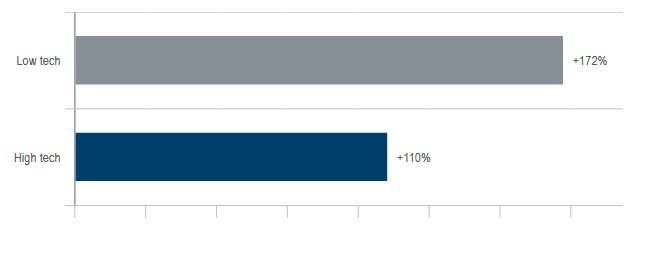
Figure 1. Increase in odds of high growth with prior use of a European patent
This well illustrates competitive advantage that a firm in a low-tech sector may gain by innovating.
Utilization of different IPR types supports SME growth potential as shown in Figure 2 (14.1% of all SMEs of the study had filed for trademark, and only 4.6% for patent).
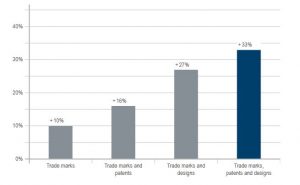
Figure 2. Increase in odds of high growth with prior use of an IPR bundle
Besides trademarks as a fundamental tool especially for consumer-oriented industries, the study found also the prior filing of patents to be a significant indicator of future HGF potential. This also implies the importance of strategic use of the IPR toolbox – how to select the tools to protect a new product or service, taking into account the various affecting dimensions, such as associated business value versus costs, scope of protection likely available, presence and nature of markets and competitors, etc.
Our IPR experts assist to prepare an IPR strategy and optimized use of the IPR toolbox to support your company. We also review current IPR status, such as assessment of coverage of current technology and/or brand related IPR portfolio with respect to product/service offering. We have unique mixture of IPR consulting expertise, many of our attorneys have earlier IPR management experience within companies.
Take contact to our expert to review your IPR status and plan how IPR can fuel your growth.
References:
(2) Eurostat classification, the low-tech domain including i.a. manufacturing of food products, beverages, textiles, wood products, paper products, and furniture

Laine IP Oy
Contact Details
Tel: (09) 6859 560
Fax: (09) 6859 5610
Email: posti@laineip.fi
Personnel Contact Information
Mailing Address
Laine IP Oy
PL 339
00181 Helsinki
Subscribe our Newsletter
Follow Us


Billing Information
Business ID: 0590525-5
VAT Number: FI05905255
Operator: Nordea
Operator ID: NDEAFIHH
e-Invoice Address: FI6221531800060138
 Contact
 Search